Java 数据结构

Java 数据结构

Java工具包提供了强大的数据结构。在Java中的数据结构主要包括以下几种接口和类:

  • 枚举(Enumeration)
  • 位集合(BitSet)
  • 向量(Vector)
  • 栈(Stack)
  • 字典(Dictionary)
  • 哈希表(Hashtable)
  • 属性(Properties)

枚举(Enumeration)

Enumeration接口中定义了一些方法,通过这些方法可以枚举(一次获得一个)对象集合中的元素。这种传统接口已被迭代器取代,虽然Enumeration 还未被遗弃,但在现代代码中已经被很少使用了。尽管如此,它还是使用在诸如Vector和Properties这些传统类所定义的方法中,除此之外,还用在一些API类,并且在应用程序中也广泛被使用。

Enumeration声明的方法:

  • boolean hasMoreElements( )测试此枚举是否包含更多的元素。

  • Object nextElement( )如果此枚举对象至少还有一个可提供的元素,则返回此枚举的下一个元素。

以下实例演示了Enumeration的使用:

1
2
3
4
5
6
7
8
9
10
11
12
13
14
15
16
17
18
19
20
21
import java.util.Vector;
import java.util.Enumeration;

public class EnumerationTester {

public static void main(String args[]) {
Enumeration<String> days;
Vector<String> dayNames = new Vector<String>();
dayNames.add("Sunday");
dayNames.add("Monday");
dayNames.add("Tuesday");
dayNames.add("Wednesday");
dayNames.add("Thursday");
dayNames.add("Friday");
dayNames.add("Saturday");
days = dayNames.elements();
while (days.hasMoreElements()){
System.out.println(days.nextElement());
}
}
}
1
2
3
4
5
6
7
Sunday
Monday
Tuesday
Wednesday
Thursday
Friday
Saturday

位集合(BitSet)

一个Bitset类创建一种特殊类型的数组来保存位值。BitSet中数组大小会随需要增加。这和位向量(vector of bits)比较类似。

这是一个传统的类,但它在Java 2中被完全重新设计。

BitSet定义了两个构造方法。

第一个构造方法创建一个默认的对象:

BitSet()
第二个方法允许用户指定初始大小。所有位初始化为0。

BitSet(int size)

下面的程序说明这个数据结构支持的几个方法:

1
2
3
4
5
6
7
8
9
10
11
12
13
14
15
16
17
18
19
20
21
22
23
24
25
26
27
28
29
30
31
32
33
34
import java.util.BitSet;

public class BitSetDemo {

public static void main(String args[]) {
BitSet bits1 = new BitSet(16);
BitSet bits2 = new BitSet(16);

// set some bits
for(int i=0; i<16; i++) {
if((i%2) == 0) bits1.set(i);
if((i%5) != 0) bits2.set(i);
}
System.out.println("Initial pattern in bits1: ");
System.out.println(bits1);
System.out.println("\nInitial pattern in bits2: ");
System.out.println(bits2);

// AND bits
bits2.and(bits1);
System.out.println("\nbits2 AND bits1: ");
System.out.println(bits2);

// OR bits
bits2.or(bits1);
System.out.println("\nbits2 OR bits1: ");
System.out.println(bits2);

// XOR bits
bits2.xor(bits1);
System.out.println("\nbits2 XOR bits1: ");
System.out.println(bits2);
}
}
1
2
3
4
5
6
7
8
9
10
11
12
13
14
Initial pattern in bits1:
{0, 2, 4, 6, 8, 10, 12, 14}

Initial pattern in bits2:
{1, 2, 3, 4, 6, 7, 8, 9, 11, 12, 13, 14}

bits2 AND bits1:
{2, 4, 6, 8, 12, 14}

bits2 OR bits1:
{0, 2, 4, 6, 8, 10, 12, 14}

bits2 XOR bits1:
{}

向量(Vector)

Vector 类实现了一个动态数组。和 ArrayList 很相似,但是两者是不同的:

  • Vector 是同步访问的。
  • Vector 包含了许多传统的方法,这些方法不属于集合框架。
    Vector 主要用在事先不知道数组的大小,或者只是需要一个可以改变大小的数组的情况。

Vector 类支持 4 种构造方法。

第一种构造方法创建一个默认的向量,默认大小为 10:

Vector()
第二种构造方法创建指定大小的向量。

Vector(int size)
第三种构造方法创建指定大小的向量,并且增量用 incr 指定。增量表示向量每次增加的元素数目。

Vector(int size,int incr)
第四种构造方法创建一个包含集合 c 元素的向量:

Vector(Collection c)

下面的程序说明这个集合所支持的几种方法:

1
2
3
4
5
6
7
8
9
10
11
12
13
14
15
16
17
18
19
20
21
22
23
24
25
26
27
28
29
30
31
32
33
34
35
36
37
38
39
40
41
42
43
44
import java.util.*;

public class VectorDemo {

public static void main(String args[]) {
// initial size is 3, increment is 2
Vector v = new Vector(3, 2);
System.out.println("Initial size: " + v.size());
System.out.println("Initial capacity: " +
v.capacity());
v.addElement(new Integer(1));
v.addElement(new Integer(2));
v.addElement(new Integer(3));
v.addElement(new Integer(4));
System.out.println("Capacity after four additions: " +
v.capacity());

v.addElement(new Double(5.45));
System.out.println("Current capacity: " +
v.capacity());
v.addElement(new Double(6.08));
v.addElement(new Integer(7));
System.out.println("Current capacity: " +
v.capacity());
v.addElement(new Float(9.4));
v.addElement(new Integer(10));
System.out.println("Current capacity: " +
v.capacity());
v.addElement(new Integer(11));
v.addElement(new Integer(12));
System.out.println("First element: " +
(Integer)v.firstElement());
System.out.println("Last element: " +
(Integer)v.lastElement());
if(v.contains(new Integer(3)))
System.out.println("Vector contains 3.");
// enumerate the elements in the vector.
Enumeration vEnum = v.elements();
System.out.println("\nElements in vector:");
while(vEnum.hasMoreElements())
System.out.print(vEnum.nextElement() + " ");
System.out.println();
}
}
1
2
3
4
5
6
7
8
9
10
11
12
Initial size: 0
Initial capacity: 3
Capacity after four additions: 5
Current capacity: 5
Current capacity: 7
Current capacity: 9
First element: 1
Last element: 12
Vector contains 3.

Elements in vector:
1 2 3 4 5.45 6.08 7 9.4 10 11 12

栈(Stack)

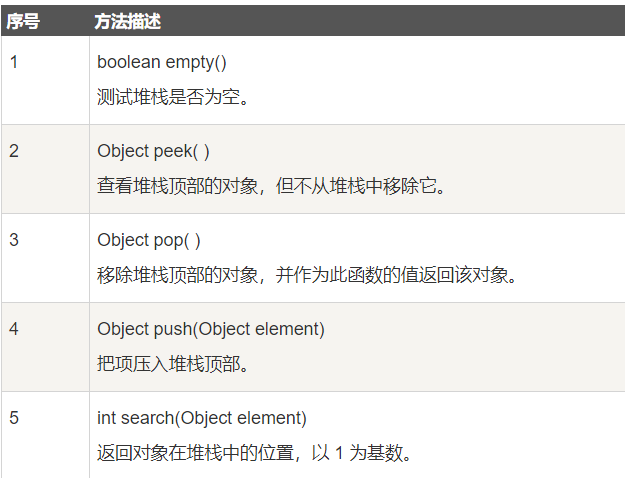
栈是Vector的一个子类,它实现了一个标准的后进先出的栈。

堆栈只定义了默认构造函数,用来创建一个空栈。 堆栈除了包括由Vector定义的所有方法,也定义了自己的一些方法。

Stack()
1

1
2
3
4
5
6
7
8
9
10
11
12
13
14
15
16
17
18
19
20
21
22
23
24
25
26
27
28
29
30
31
32
33
import java.util.*;

public class StackDemo {

static void showpush(Stack<Integer> st, int a) {
st.push(new Integer(a));
System.out.println("push(" + a + ")");
System.out.println("stack: " + st);
}

static void showpop(Stack<Integer> st) {
System.out.print("pop -> ");
Integer a = (Integer) st.pop();
System.out.println(a);
System.out.println("stack: " + st);
}

public static void main(String args[]) {
Stack<Integer> st = new Stack<Integer>();
System.out.println("stack: " + st);
showpush(st, 42);
showpush(st, 66);
showpush(st, 99);
showpop(st);
showpop(st);
showpop(st);
try {
showpop(st);
} catch (EmptyStackException e) {
System.out.println("empty stack");
}
}
}
1
2
3
4
5
6
7
8
9
10
11
12
13
14
stack: [ ]
push(42)
stack: [42]
push(66)
stack: [42, 66]
push(99)
stack: [42, 66, 99]
pop -> 99
stack: [42, 66]
pop -> 66
stack: [42]
pop -> 42
stack: [ ]
pop -> empty stack

字典(Dictionary)

Dictionary 类是一个抽象类,用来存储键/值对,作用和Map类相似。

给出键和值,你就可以将值存储在Dictionary对象中。一旦该值被存储,就可以通过它的键来获取它。所以和Map一样, Dictionary 也可以作为一个键/值对列表。

Dictionary类已经过时了。在实际开发中,你可以实现Map接口来获取键/值的存储功能。

Java Map 接口

Map接口中键和值一一映射. 可以通过键来获取值。

  • 给定一个键和一个值,你可以将该值存储在一个Map对象. 之后,你可以通过键来访问对应的值。
  • 当访问的值不存在的时候,方法就会抛出一个NoSuchElementException异常.
  • 当对象的类型和Map里元素类型不兼容的时候,就会抛出一个 ClassCastException异常。
  • 当在不允许使用Null对象的Map中使用Null对象,会抛出一个NullPointerException 异常。
  • 当尝试修改一个只读的Map时,会抛出一个UnsupportedOperationException异常。
1
2
3
4
5
6
7
8
9
10
11
12
13
14
15
import java.util.*;

public class CollectionsDemo {

public static void main(String[] args) {
Map m1 = new HashMap();
m1.put("Zara", "8");
m1.put("Mahnaz", "31");
m1.put("Ayan", "12");
m1.put("Daisy", "14");
System.out.println();
System.out.println(" Map Elements");
System.out.print("\t" + m1);
}
}
1
2
Map Elements
{Mahnaz=31, Ayan=12, Daisy=14, Zara=8}

哈希表(Hashtable)

Hashtable是原始的java.util的一部分, 是一个Dictionary具体的实现 。

然而,Java 2 重构的Hashtable实现了Map接口,因此,Hashtable现在集成到了集合框架中。它和HashMap类很相似,但是它支持同步。

像HashMap一样,Hashtable在哈希表中存储键/值对。当使用一个哈希表,要指定用作键的对象,以及要链接到该键的值。

然后,该键经过哈希处理,所得到的散列码被用作存储在该表中值的索引。

Hashtable定义了四个构造方法。第一个是默认构造方法:

Hashtable()
第二个构造函数创建指定大小的哈希表:

Hashtable(int size)
第三个构造方法创建了一个指定大小的哈希表,并且通过fillRatio指定填充比例。

填充比例必须介于0.0和1.0之间,它决定了哈希表在重新调整大小之前的充满程度:

Hashtable(int size,float fillRatio)
第四个构造方法创建了一个以M中元素为初始化元素的哈希表。

哈希表的容量被设置为M的两倍。

Hashtable(Map m)

1
2
3
4
5
6
7
8
9
10
11
12
13
14
15
16
17
18
19
20
21
22
23
24
25
26
27
28
29
30
31
32
import java.util.*;

public class HashTableDemo {

public static void main(String args[]) {
// Create a hash map
Hashtable balance = new Hashtable();
Enumeration names;
String str;
double bal;

balance.put("Zara", new Double(3434.34));
balance.put("Mahnaz", new Double(123.22));
balance.put("Ayan", new Double(1378.00));
balance.put("Daisy", new Double(99.22));
balance.put("Qadir", new Double(-19.08));

// Show all balances in hash table.
names = balance.keys();
while(names.hasMoreElements()) {
str = (String) names.nextElement();
System.out.println(str + ": " +
balance.get(str));
}
System.out.println();
// Deposit 1,000 into Zara's account
bal = ((Double)balance.get("Zara")).doubleValue();
balance.put("Zara", new Double(bal+1000));
System.out.println("Zara's new balance: " +
balance.get("Zara"));
}
}
1
2
3
4
5
6
7
Qadir: -19.08
Zara: 3434.34
Mahnaz: 123.22
Daisy: 99.22
Ayan: 1378.0

Zara's new balance: 4434.34

属性(Properties)

Properties 继承于 Hashtable.表示一个持久的属性集.属性列表中每个键及其对应值都是一个字符串。

Properties 类被许多Java类使用。例如,在获取环境变量时它就作为System.getProperties()方法的返回值。

Properties 定义如下实例变量.这个变量持有一个Properties对象相关的默认属性列表。

Properties defaults;
Properties类定义了两个构造方法. 第一个构造方法没有默认值。

Properties()
第二个构造方法使用propDefault 作为默认值。两种情况下,属性列表都为空:

Properties(Properties propDefault)

1
2
3
4
5
6
7
8
9
10
11
12
13
14
15
16
17
18
19
20
21
22
23
24
25
26
27
28
29
30
31
import java.util.*;

public class PropDemo {

public static void main(String args[]) {
Properties capitals = new Properties();
Set states;
String str;

capitals.put("Illinois", "Springfield");
capitals.put("Missouri", "Jefferson City");
capitals.put("Washington", "Olympia");
capitals.put("California", "Sacramento");
capitals.put("Indiana", "Indianapolis");

// Show all states and capitals in hashtable.
states = capitals.keySet(); // get set-view of keys
Iterator itr = states.iterator();
while(itr.hasNext()) {
str = (String) itr.next();
System.out.println("The capital of " +
str + " is " + capitals.getProperty(str) + ".");
}
System.out.println();

// look for state not in list -- specify default
str = capitals.getProperty("Florida", "Not Found");
System.out.println("The capital of Florida is "
+ str + ".");
}
}
1
2
3
4
5
6
7
The capital of Missouri is Jefferson City.
The capital of Illinois is Springfield.
The capital of Indiana is Indianapolis.
The capital of California is Sacramento.
The capital of Washington is Olympia.

The capital of Florida is Not Found.
Donate? comment?